webinar
Do More Efficient Schools Produce Better Outcomes – Evidence from India
Despite a noteworthy progress in school access and enrollment at the elementary level in India, there are considerable disparities in school performances at the secondary level. Researchers found that low productivity of resources in public schools reflects the inherent weakness in resource management in public education (Duflo, Dupas, and Kremer, 2015). This study investigates whether substantial improvement in student outcomes is possible by improving the productive efficiency of school resources.
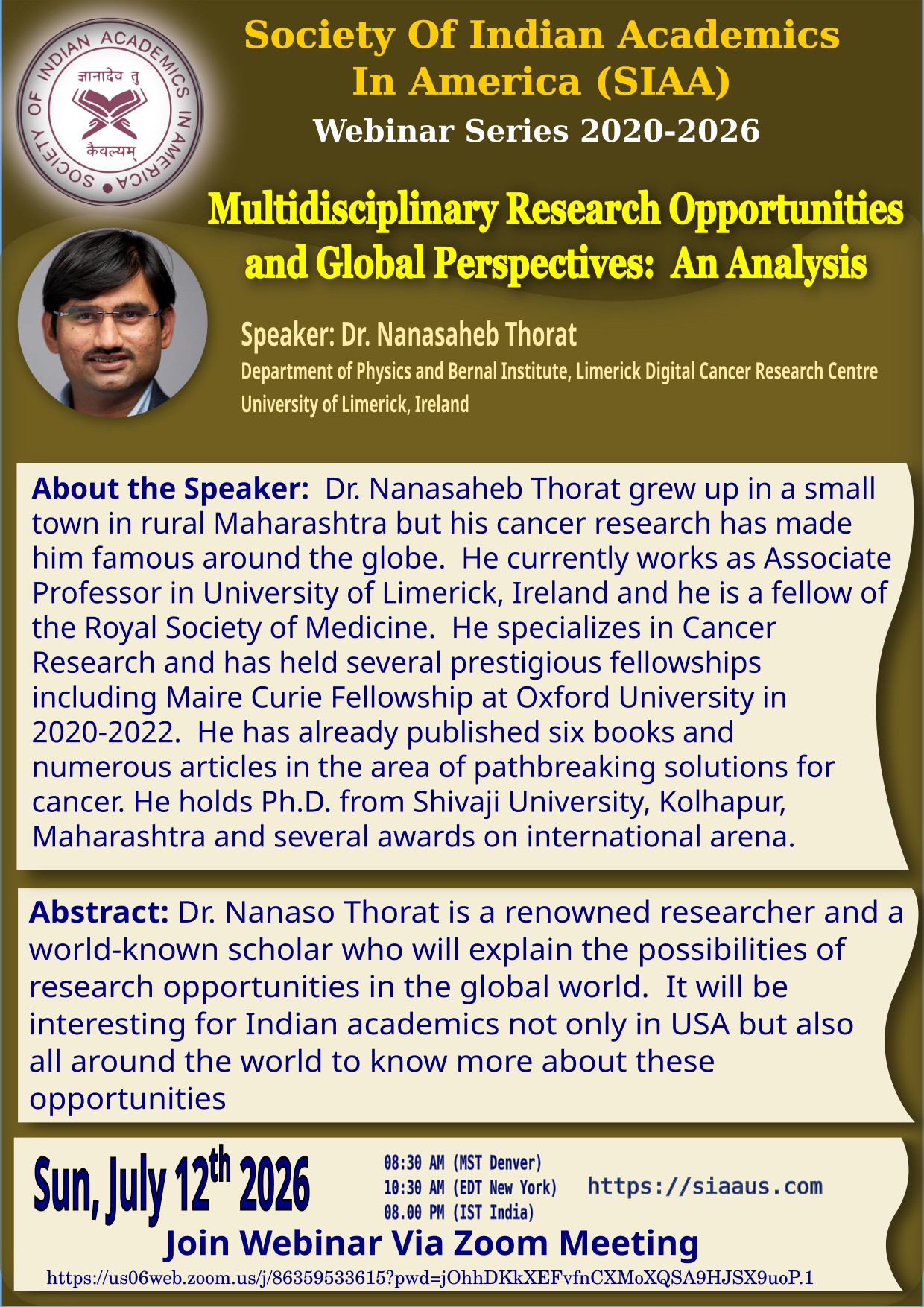
Multidisciplinary Research Opportunities and Global Perspectives: An Analysis
Abstract: Dr. Nanaso Thorat is a renowned researcher and a world-known scholar who will explain the possibilities of research opportunities in the global world. It will be interesting for Indian academics not only in USA but also all around the world to know more about these opportunities
From Cloud to Edge – The future of Artificial Intelligence
Artificial intelligence (AI) loosely refers to the ability of a digital computer to perform tasks commonly associated with intelligent beings – the ability to reason, discover meaning, generalize, or learn from experience. Though the concept was first introduced in the 1930s, by 2020 progress in computing and networking led to deployment of AI in fields as diverse as medical diagnosis, computer search engines, voice or handwriting recognition, autonomous vehicles and chatbots.
Misconceptions about Ayurveda: Dismissal and glorification in contemporary debate
Ayurveda today is a historically layered medical tradition rather than an unchanged ancient science. Its classical Saṃhitā framework is comparable to other premodern systems such as Galenic medicine; however, unlike Europe where such traditions were replaced by experimental biomedicine, contemporary Ayurveda retains continuity with its classical theories while also incorporating certain elements from current science.
Knowledge vs Knowledge Systems in Indian Knowledge Systems
This talk is the result of a pursuit of the epistemology and ontology of Academic Knowledge that we have been engaged with over the last four decades. Indian Knowledge Systems (IKS) was proposed in India in the National Education Policy 2020.
Why, then, is Ayurveda, the sciences of health, illness, and healing that originated in the Indian Subcontinent, dismissed as pseudoscience?
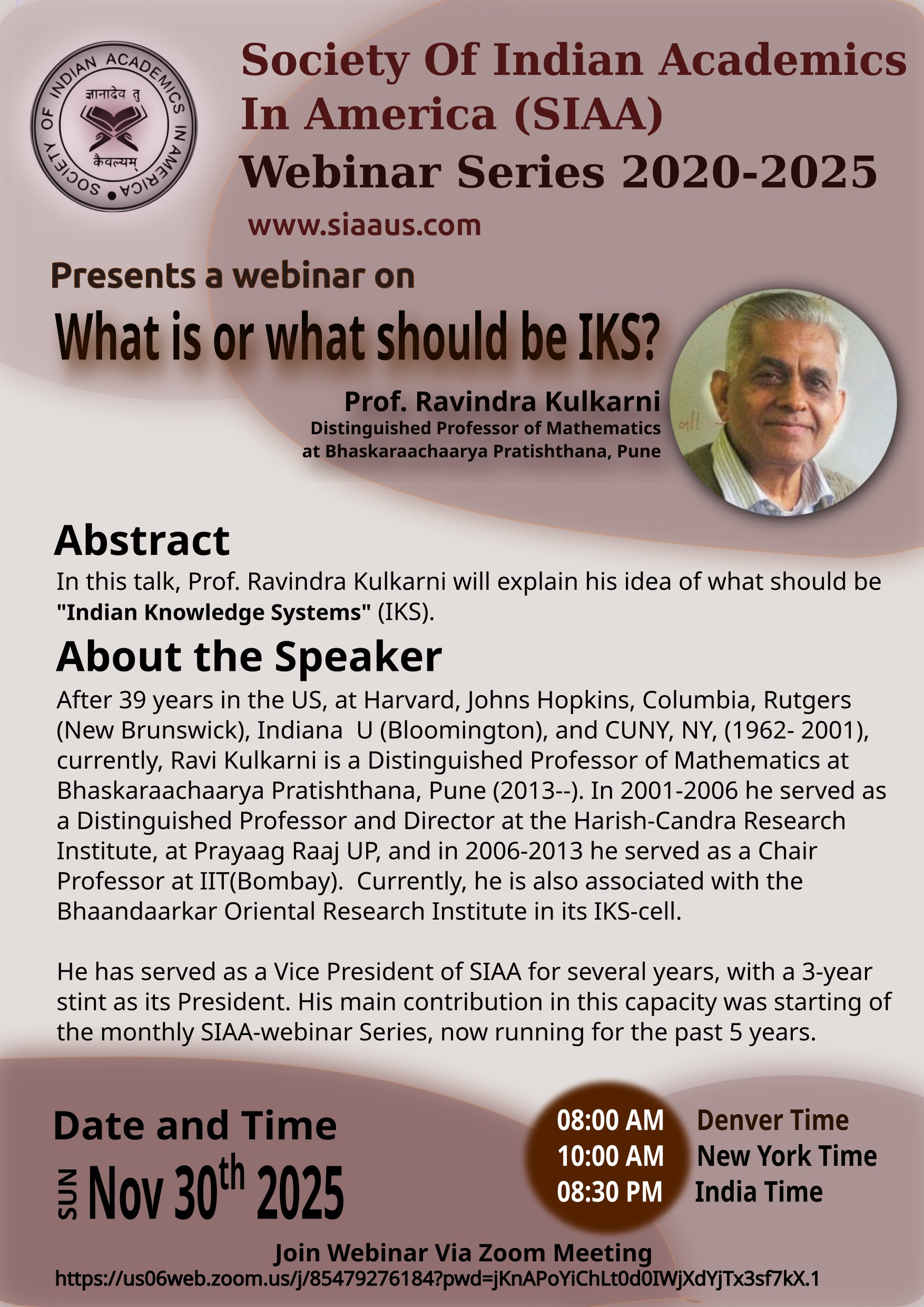
What is or what should be IKS?
In this talk, I will explain my idea of what should be "Indian Knowledge Systems" (IKS).
Mathematics education -- an Indian view from below, and from above
While Dr. Ramanujam is a researcher in logic and automata theory, he also has been active in adult education and school science and mathematics education over the last three decades in India, mostly with the poorest sections of society. This work has also led him to participate in committees at the national and state level. These two views of education, from high above in the committees, and from the ground in villages and urban slums, are in sharp contrast, and he will talk about his learning from this.
A Buddhist Perspective on the Environment: Karuṇā and Pratītyasamutpāda
It is no secret that the world is facing an environmental crisis. Why should one care? And what should we do? These are questions that concern any thoughtful person. The answer to them depends, of course, on one’s philosophical views—most crucially, ethical and political. In this talk I will provide an answer to the questions from the perspective of Buddhist philosophy. No prior knowledge of Buddhist thought will be presumed.
Challenges in Construction of Ram Mandir in Ayodhy
This presentation includes the Pre-historic & Engineering development chronology & methods of planning as well as constructions adopted so far.
The Monumental Construction of Shri Ramlalla Mandir at Ayodhya began after the 450 years of struggle & HSC verdict on 9th Nov’2019. Now, this has become devotional movement of National importance.
Revealing India's Deep Antiquity
The focus of much of Indology in the West, unfortunately, is on the social narratives in India’s epics and ancient texts, with very little exploration of science contained within or evidentiary assessment from scientific perspective.
We shall take a fresh, scientific evidence-focused approach to studying the history of Indian Civilization.